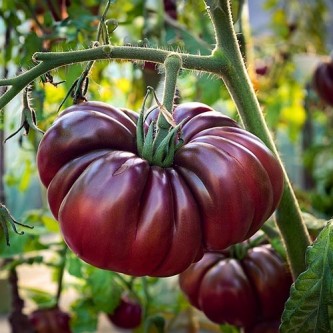
Beefsteak tomato Calabash Red is an organically grown beefsteak tomato variety. It is a distinctive, old tomato cultivar belonging to the heritage or heirloom group. This tomato is known for its striking appearance, historical background, and mild flavor. Calabash Red originates from Chiapas, Mexico, and has been cultivated for a very long time. There are indications that similar Calabash-type tomatoes were already known by the late 18th century. This variety is sometimes confused with Purple Calabash, but that cultivar has a dark purple-brown color, whereas Calabash Red remains clearly red. The fruits are flat and deeply ribbed, giving them a characteristic and almost decorative appearance. Both the skin and the flesh are bright red in color. The fruits weigh on average between 115 and 135 grams and have a thin skin. This makes them juicy and pleasant to eat raw, but also more susceptible to cracking when watering is irregular or excessive. The flavour is generally described as mild, lightly sweet, and fresh. As a result, Calabash Red beefsteak tomatoes are especially popular in salads and other dishes where the tomato is eaten raw or only lightly processed. For long-term processing, such as preserving, they are somewhat less suitable than firmer varieties.
The plant has an indeterminate growth habit, meaning it continues to grow throughout the season and regularly produces new flowers and fruits. Therefore, support with stakes or a tomato cage is necessary. It is a mid- to late-season variety that performs best in a sunny, warm location with fertile, well-drained soil. As a true-breeding heirloom variety, seeds can be saved and sown again the following year while retaining the same characteristics. This makes Calabash Red interesting not only for home gardeners but also for enthusiasts of historical and unusual vegetable varieties. Use these tomatoes in pasta sauces, salads, in soups, ketchup, as stuffed tomatoes, on bread and in other dishes in which you use tomatoes. Ensure adequate sun and warmth and support the plant well for best results.Tomatoes are high in vitamin C and lycopene. This is best absorbed into the body when tomatoes have been heated. Non hardy annual. Height: 250 - 350 cm.
Indoor sowing: February - April
Germination: 6 - 14 days
Germination temp: 20 - 25 °C
Sowing depth: 2 - 3 mm
Transplanting: when the seedlings are about 20 cm tall
Transplanting in garden: in May, after the last night frosts
Plant spacing: 45 - 50 cm
Planting position: sunny - sheltered (greenhouse)
Days till harvest: 60 - 90
Sow indoors from February on in trays filled with moist pottingsoil. Sow shallow and press the seeds gently in the soil, don't cover them with soil, because tomatoes are light germinators. Put the trays away somewhere warm at 20 - 25 °C and cover them with clingfilm or a lid. Keep the temperature as even as possible and don't let the temperature drop during the night. Keep moist, but not to wet to prevent rotting of the seeds. Remove the clingfilm or lid when the seedlings emerge. Transplant the seedlings to seperate pots approx. 10 days after emerging. Put them away a bit cooler at approx. 18 - 20 °C.
Harden the tomatoes of, from the middle of May, when there's no longer any danger of nightfrosts. Put the pots at a temperature of 15 - 18 °C for a week and reduce the amount of water for this week. Put the plants outdoors after this week on a sunny and sheltered plot with well draining soil or put them in a greenhouse. Make sure that there is no longer any nightfrost.
Tomatoes need some maintenance to ensure a good harvest. Give the plants a sturdy support with some sturdy and large bamboo sticks. Remove all suckers that will form in the axils of your plants. Remove all the leaves below the lowest hanging fruits by the end of July till the beginning of August. Remove all the leaves of all plants together with the tops of all plants from the end of August till the beginning of September to ensure the ripening of most of the green tomatoes. Harvest the tomatoes by cutting them with scissors. Tomatoes can't be kept for a long period. Don't keep your harvested tomatoes in the fridge. So use them a soon as possible after harvesting. Tomatoes used in sauces can be kept frozen to store.